3 posts tagged with "SAP Integration"

SAP system integration

View All Tags

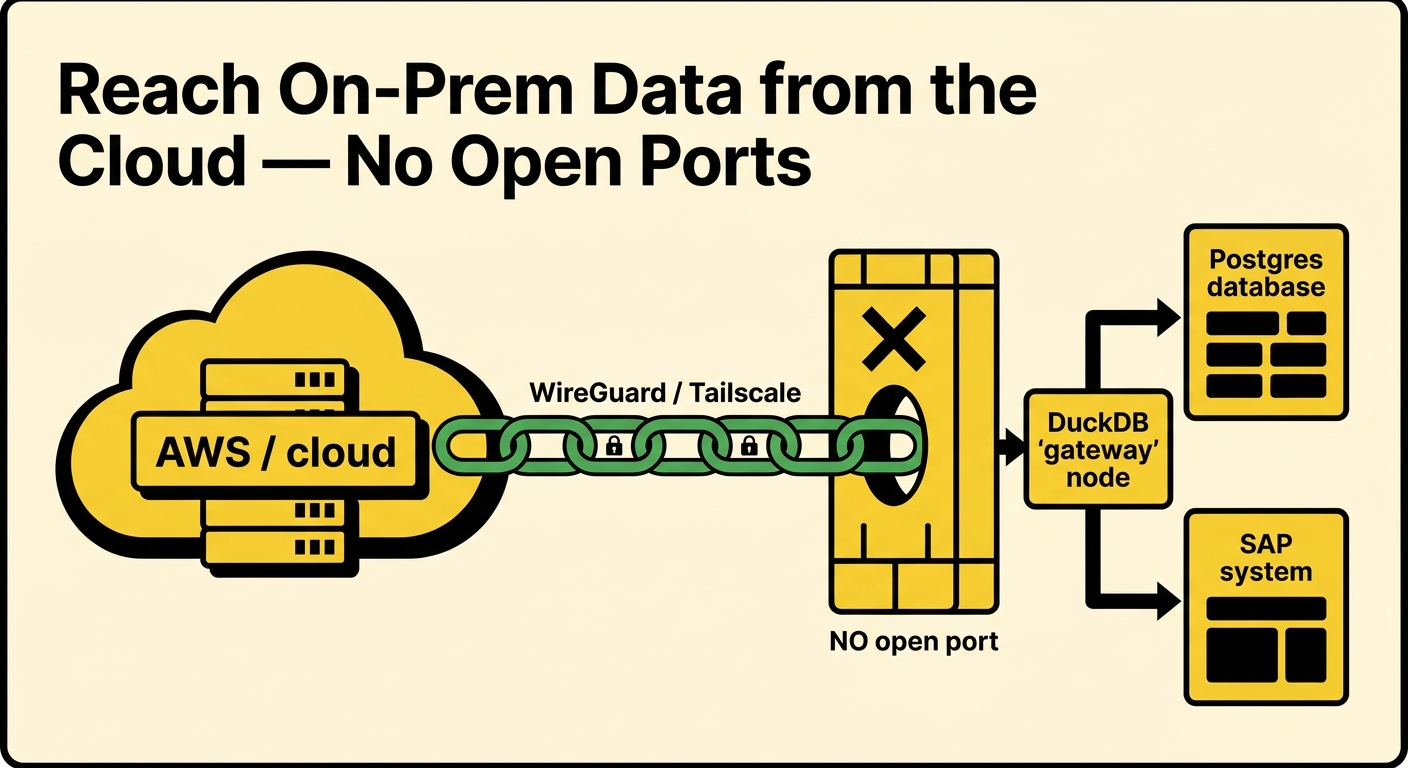
Reach On-Prem Postgres and SAP from a Cloud Container — Without Opening a Port

· 8 min read
Joachim Rosskopf
Co-Founder & CEO

A cloud container reaching an on-premise Postgres and SAP system through a DuckDB gateway on a Tailscale tailnet, with no inbound firewall port.

Here is a problem that shows up on every hybrid-cloud project eventually. You have a container in the cloud — an AWS ECS task, a Fargate job, an analytics or AI workload — and it needs data that lives in an on-prem network: a Postgres database, or an SAP system reachable only from inside the corporate LAN.

The data is right there. The container just can't reach it. And the moment you ask, the answer from the network team is no: no inbound firewall port to the on-prem network, no public IP on the database, no exception. That's not obstruction — it's the correct default. An open port into your ERP network is exactly what you don't want.

So the usual workarounds start: a site-to-site VPN, a bastion host with SSH port-forwards, an IP allowlist someone has to maintain, a reverse proxy in a DMZ. Each one is a standing piece of infrastructure, and each one is a thing that can be misconfigured into an open door.

There's a smaller way to do this, and it doesn't open a port at all.

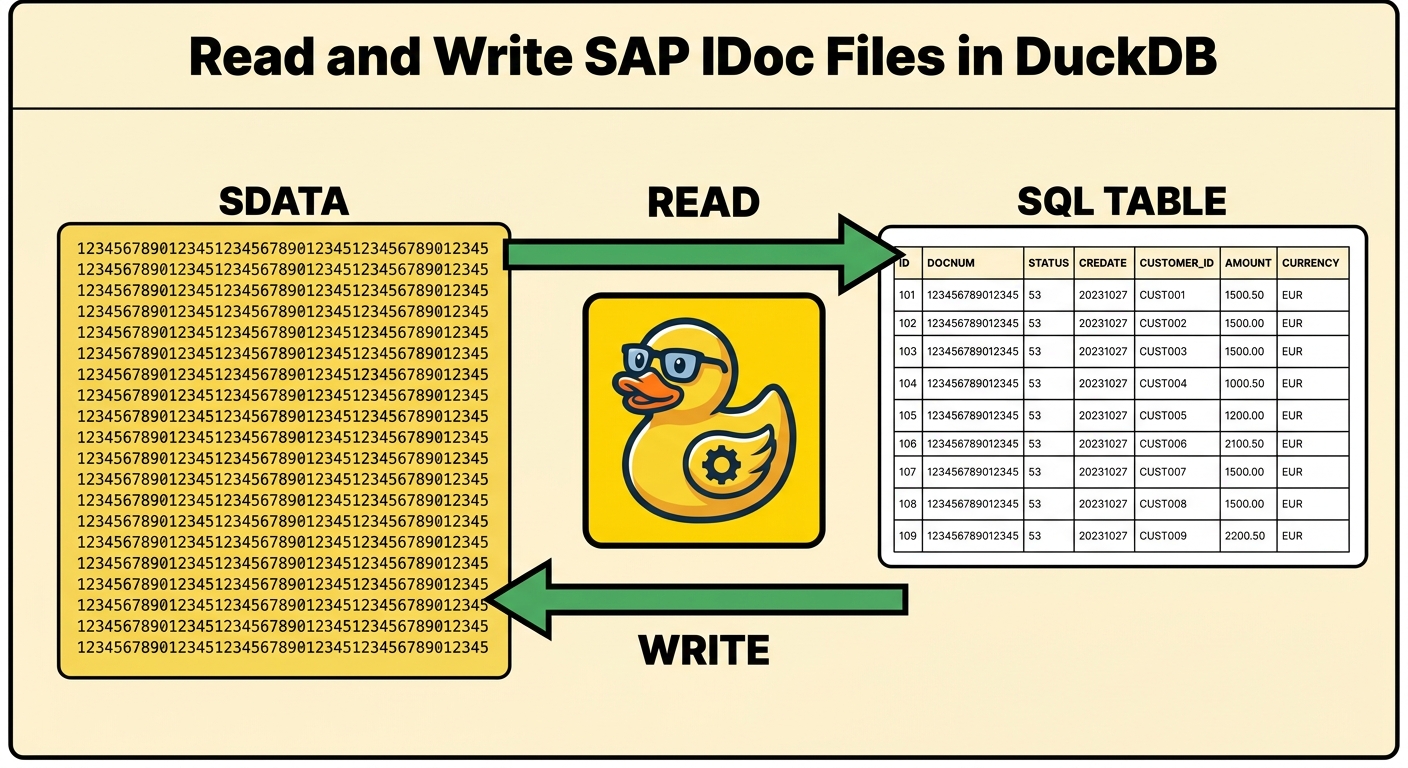
Read and Write SAP IDoc Files as SQL Tables in DuckDB

· 7 min read
Joachim Rosskopf
Co-Founder & CEO

Reading and writing SAP IDoc files as SQL in DuckDB — decode the opaque fixed-width SDATA into columns, and write byte-valid IDocs back, offline.

If you have ever worked an SAP EDI or ALE interface, you have seen an IDoc file: a flat text file where every line is exactly 1063 characters, and the payload — the field called SDATA — is a 1000-character run with no delimiters. No commas, no tags, no header. Just a fixed-width blob whose meaning lives in a segment definition inside SAP.

That's the problem. To read what's actually in an IDoc you open SAP: transaction WE60 for the segment layout, WE02 to look at the document. Outside SAP, an IDoc file is opaque. You can't grep it in any useful way, you can't load it into a warehouse, and you certainly can't diff two of them field by field.

erpl_idoc is a DuckDB extension that fixes that. It reads IDoc files as SQL tables, decodes the SDATA blob into typed columns, writes byte-valid IDocs back out from a query, and converts flat ⇄ IDoc-XML — all in plain SQL, and all offline. No SAP connection, no RFC libraries, no middleware.

And it goes both ways. The same extension that lands an inbound file as a table also produces an outbound one: compose the records in SQL, COPY them to disk, and you get a byte-valid IDoc a SAP file-port will accept. Read and write, on one file engine.