14 posts tagged with "DuckDB"

DuckDB database tutorials

View All Tags

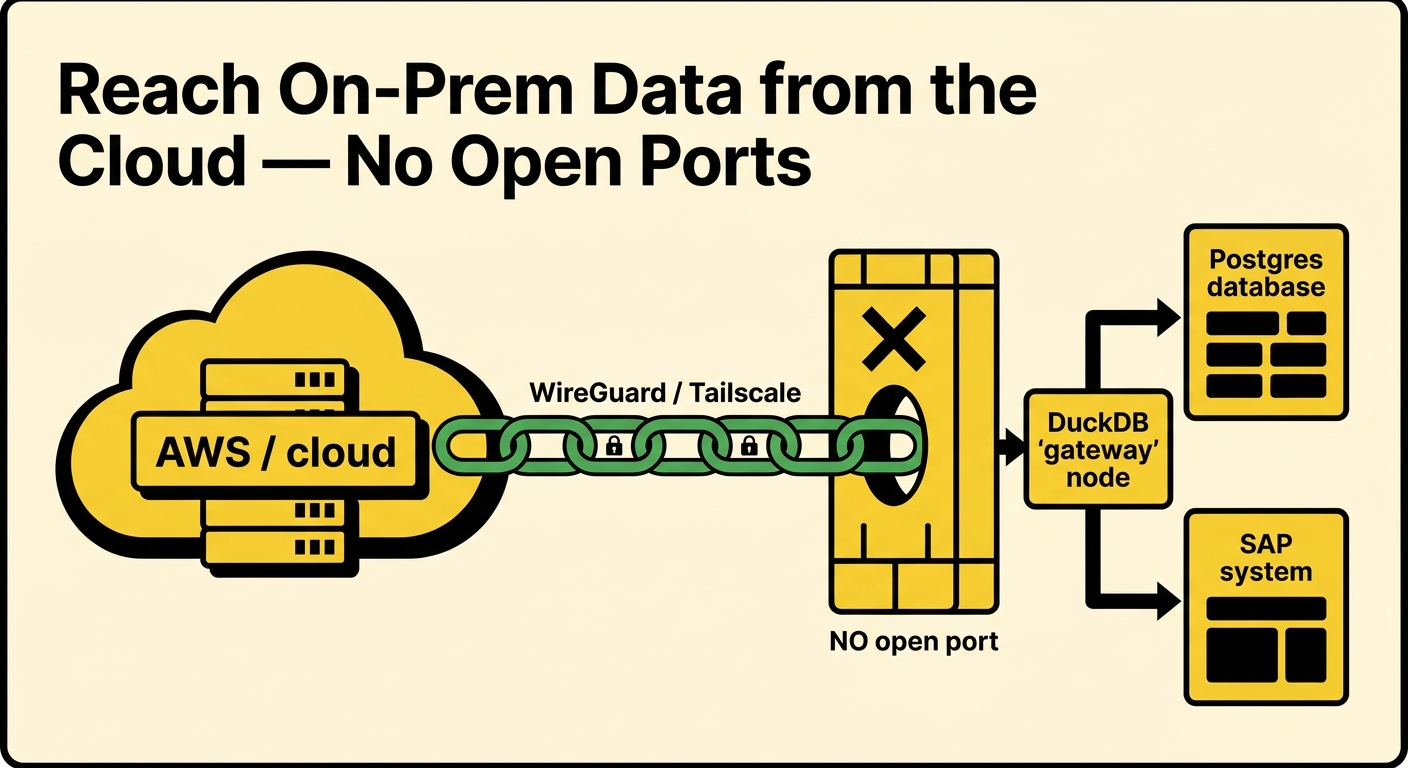
Reach On-Prem Postgres and SAP from a Cloud Container — Without Opening a Port

· 8 min read
Joachim Rosskopf
Co-Founder & CEO

A cloud container reaching an on-premise Postgres and SAP system through a DuckDB gateway on a Tailscale tailnet, with no inbound firewall port.

Here is a problem that shows up on every hybrid-cloud project eventually. You have a container in the cloud — an AWS ECS task, a Fargate job, an analytics or AI workload — and it needs data that lives in an on-prem network: a Postgres database, or an SAP system reachable only from inside the corporate LAN.

The data is right there. The container just can't reach it. And the moment you ask, the answer from the network team is no: no inbound firewall port to the on-prem network, no public IP on the database, no exception. That's not obstruction — it's the correct default. An open port into your ERP network is exactly what you don't want.

So the usual workarounds start: a site-to-site VPN, a bastion host with SSH port-forwards, an IP allowlist someone has to maintain, a reverse proxy in a DMZ. Each one is a standing piece of infrastructure, and each one is a thing that can be misconfigured into an open door.

There's a smaller way to do this, and it doesn't open a port at all.

Read and Write SAP IDoc Files as SQL Tables in DuckDB

· 7 min read
Joachim Rosskopf
Co-Founder & CEO

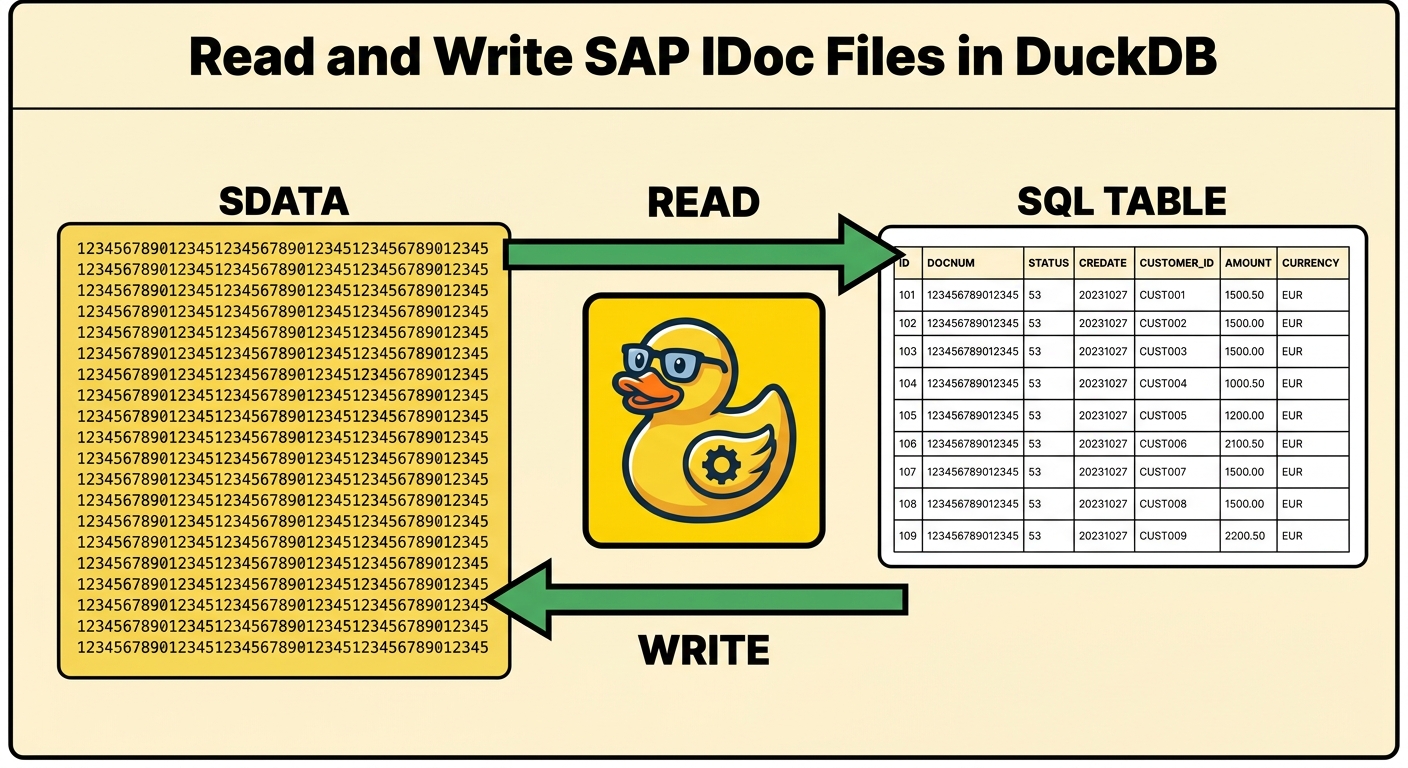
Reading and writing SAP IDoc files as SQL in DuckDB — decode the opaque fixed-width SDATA into columns, and write byte-valid IDocs back, offline.

If you have ever worked an SAP EDI or ALE interface, you have seen an IDoc file: a flat text file where every line is exactly 1063 characters, and the payload — the field called SDATA — is a 1000-character run with no delimiters. No commas, no tags, no header. Just a fixed-width blob whose meaning lives in a segment definition inside SAP.

That's the problem. To read what's actually in an IDoc you open SAP: transaction WE60 for the segment layout, WE02 to look at the document. Outside SAP, an IDoc file is opaque. You can't grep it in any useful way, you can't load it into a warehouse, and you certainly can't diff two of them field by field.

erpl_idoc is a DuckDB extension that fixes that. It reads IDoc files as SQL tables, decodes the SDATA blob into typed columns, writes byte-valid IDocs back out from a query, and converts flat ⇄ IDoc-XML — all in plain SQL, and all offline. No SAP connection, no RFC libraries, no middleware.

And it goes both ways. The same extension that lands an inbound file as a table also produces an outbound one: compose the records in SQL, COPY them to disk, and you get a byte-valid IDoc a SAP file-port will accept. Read and write, on one file engine.

Reverse-Engineer a SAP BW Cube into dbt Models on DuckDB

· 10 min read
Joachim Rosskopf
Co-Founder & CEO

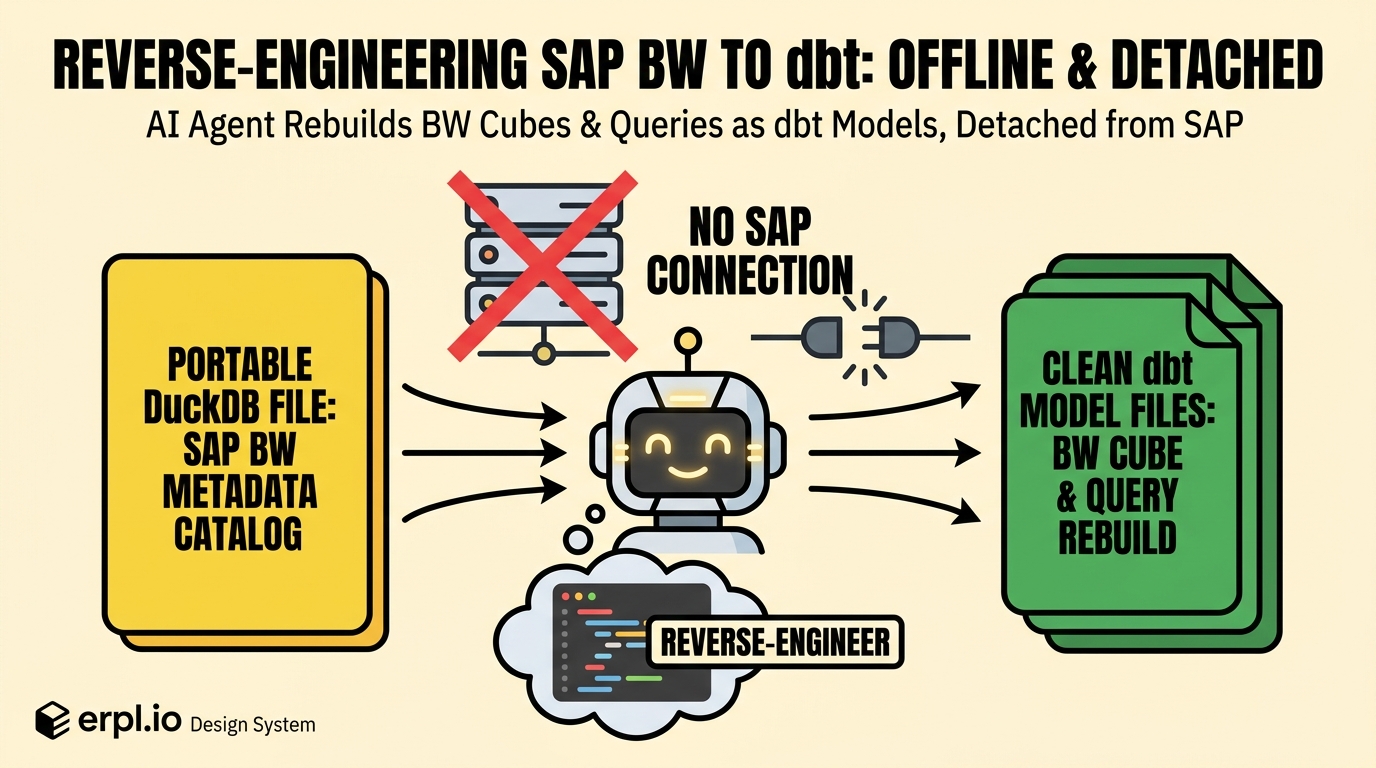
An AI agent reverse-engineering a BW cube into dbt models, offline, with no SAP connection.

In Part 1 we extracted a BW system's metadata into a single DuckDB file with erpl-adt catalog sync — 53 cubes, 226 queries, every characteristic and key figure, all the lineage between them. Browsable, searchable, and completely decoupled from SAP.

Now we do the interesting thing. We unplug.

No SAP credentials in this post. No VPN, no connection, no --host. Just catalog.duckdb — the file from Part 1 — and an AI agent. The goal: take one cube (0D_NW_C01, "Actual for NW Demo") and its flagship query (0D_FC_NW_C01_Q0008, "YTD Sales by Sales Org") and reverse-engineer them into runnable dbt models on DuckDB. Reconstruct the star schema, the measures, and the year-to-date logic — from metadata alone, offline.

Here is exactly how it went.

Extract SAP BW Metadata into a DuckDB Catalog

· 7 min read
Joachim Rosskopf
Co-Founder & CEO

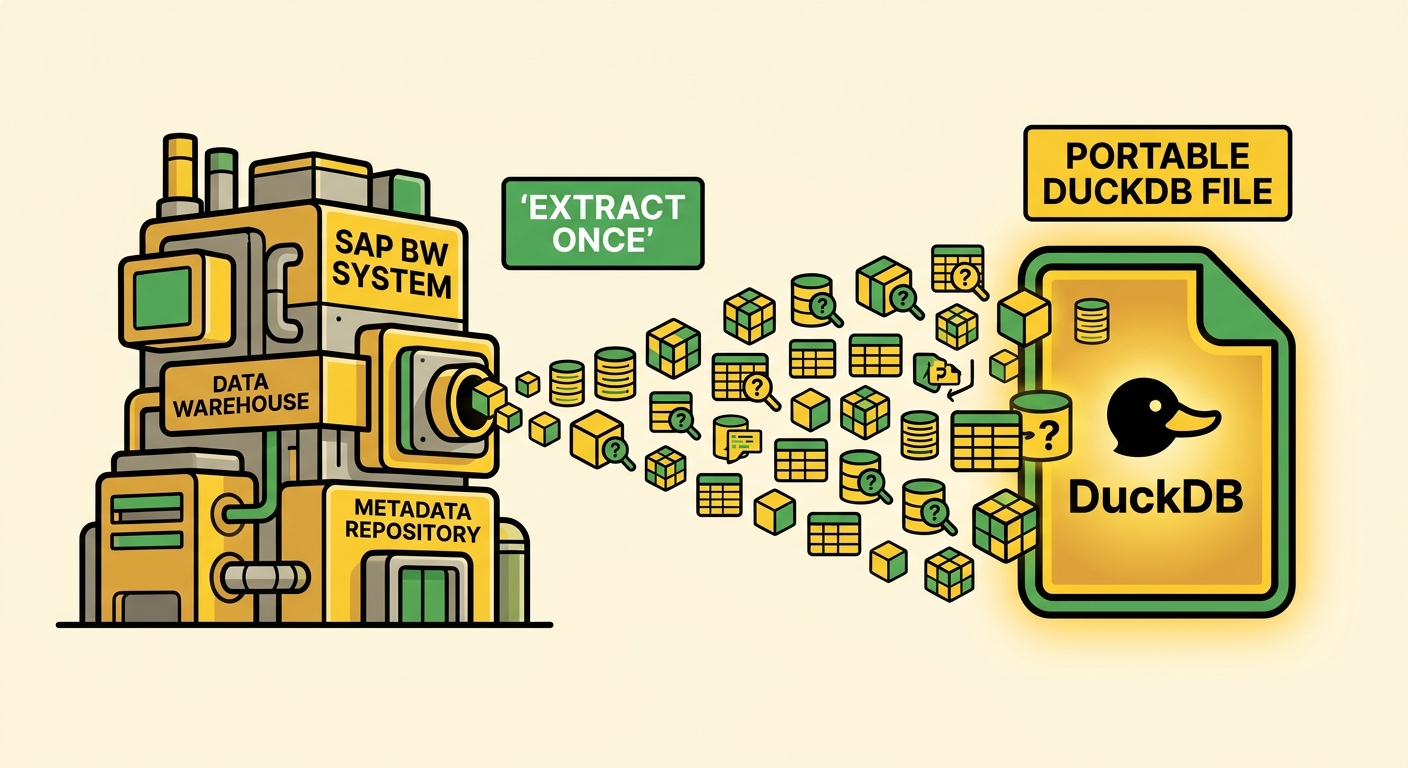
Extracting SAP BW metadata into a single portable DuckDB file.

You inherit a BW system the way you inherit an old house: with the previous owner already gone and no manual in the drawer. There is a cube called 0D_NW_C01. There is a query called 0D_FC_NW_C01_Q0008. Somebody, once, knew exactly what each of them meant. That person left, and the knowledge left with them.

This is one of the quiet costs of enterprise data work: the metadata is in SAP, but it isn't easy to carry with you. To see what a cube contains you open the Data Warehousing Workbench. To read a query definition you open the Query Designer. To trace where a number comes from you open transaction after transaction, screenshotting as you go, because there is no other place to keep the answer.

I wanted that metadata in a file I could keep: cubes, queries, InfoObjects, characteristics, key figures, CDS views, and the links between them — something I could reason about without SAP in the loop.

That is what the erpl-adt catalog does. This post is Part 1: extract it, and browse it. Part 2 unplugs from SAP entirely and hands the file to an AI agent.

erpl-rev: SAP Calls Out into DuckDB — 10 Million Rows a Minute

· 9 min read
Joachim Rosskopf
Co-Founder & CEO

Picture the data team at a mid-sized manufacturer. Every night they need a fresh copy of the FI line items — BSEG and friends — in their lakehouse, where the analysts actually live: DuckDB, Parquet on object storage, the odd Iceberg table. The table is wide (hundreds of columns) and deep (tens of millions of rows), and the window is tight. The "official" answer is SLT: stand up a replication server, license it, configure the per-table settings in LTRS, babysit the queue. It works. It is also a lot of machinery — and budget — for what is, conceptually, "read this table fast and write it somewhere open."

I wanted to know how far the cheap path goes. SAP already exposes a perfectly good remote-function interface; DuckDB already ingests at memory bandwidth. What if ABAP just called out into DuckDB — no extension inside SAP, no SLT, no staging files — and we made the read fast enough to matter?

So I built it — two days, with Claude Code as the pair programmer. The result is erpl-rev, and on a throwaway SAP developer trial (single host, over loopback) it replicated 10,000,000 rows of a 400-column BSEG-shaped table in about a minute. It's an early release — a research prototype we're opening up, not an SLT replacement yet — but the numbers were enough to convince me the cheap path is real. Here is the story, the tools, and the numbers.

An AI Agent That Calls Live SAP Data — and Fixes It in ABAP

· 8 min read
Joachim Rosskopf
Co-Founder & CEO

← Part 1: Your SAP Data Is Already Real-Time

In Part 1, a mid-size manufacturer's forecasting team got a live, validated, DuckDB-native view of their SAP order and customer data — fresh within five minutes, anomalies caught at the gate, no warehouse in the middle.

This post is Part 2. It answers the next two questions: how does the AI agent actually reach that data, and what happens when the data is wrong?

The short version: we publish the view as a REST endpoint and an MCP tool with flAPI so the agent can call it, and when the agent finds a bad number it reads the ABAP behind the view, writes a patch, and files a transport with erpl-adt.

Your SAP Data Is Already Real-Time — You Just Need to Stop Caching It

· 8 min read
Joachim Rosskopf
Co-Founder & CEO

Picture a forecasting team at an industrial-controls Mittelstand. Their job for the next quarter: launch an AI-driven inventory and demand-forecasting tool that the operations team will actually trust enough to act on. They have the model. They have the GPUs. They cannot ship.

The reason: their nightly ETL job runs at 02:00 and finishes around 04:00, by which point the model trains on data that's already half a day old. By the time the forecast reaches the procurement system at 08:00, it's reasoning about a world that existed fourteen hours ago. When the CFO asks why the model recommended ordering more of an item that just sold out at lunchtime, nobody has a good answer — because the data the model saw never knew the lunchtime existed.

The fix isn't a better ETL. The fix is removing the ETL.

Effortlessly Fetch Public Holiday Data with DuckDB and ERPL-Web Extension

· 4 min read
Simon Müller
Co-Founder & CTO

Summary

DuckDB is a high-performance SQL OLAP database system known for its efficiency in handling analytical queries. However, accessing and analyzing public holiday data across different countries and date ranges can be challenging. By leveraging the ERPL-Web extension, you can seamlessly fetch and process this data within DuckDB.

We demonstrate how to retrieve public holiday data for Germany, showcasing the ease and power of this approach. This example highlights how DuckDB and ERPL-Web can streamline your data workflows by connecting your SQL environment with external data sources efficiently.

Excel-Parquet Integration: Mastering Data Analysis with DuckDB

· 5 min read
Simon Müller
Co-Founder & CTO

Summary

  • The article guides on integrating Excel with Parquet files using DuckDB, highlighting the efficiency of DuckDB for large data sets and how it surpasses Excel's normal data handling limits.
  • It includes step-by-step instructions for installing the DuckDB ODBC driver, configuring Excel, setting up the ODBC connection, and suggests using Power Query Desktop for data transformation.