6 posts tagged with "AI"

AI-powered development and automation

View All Tags

Reverse-Engineer a SAP BW Cube into dbt Models on DuckDB

· 10 min read

Joachim Rosskopf
Co-Founder & CEO

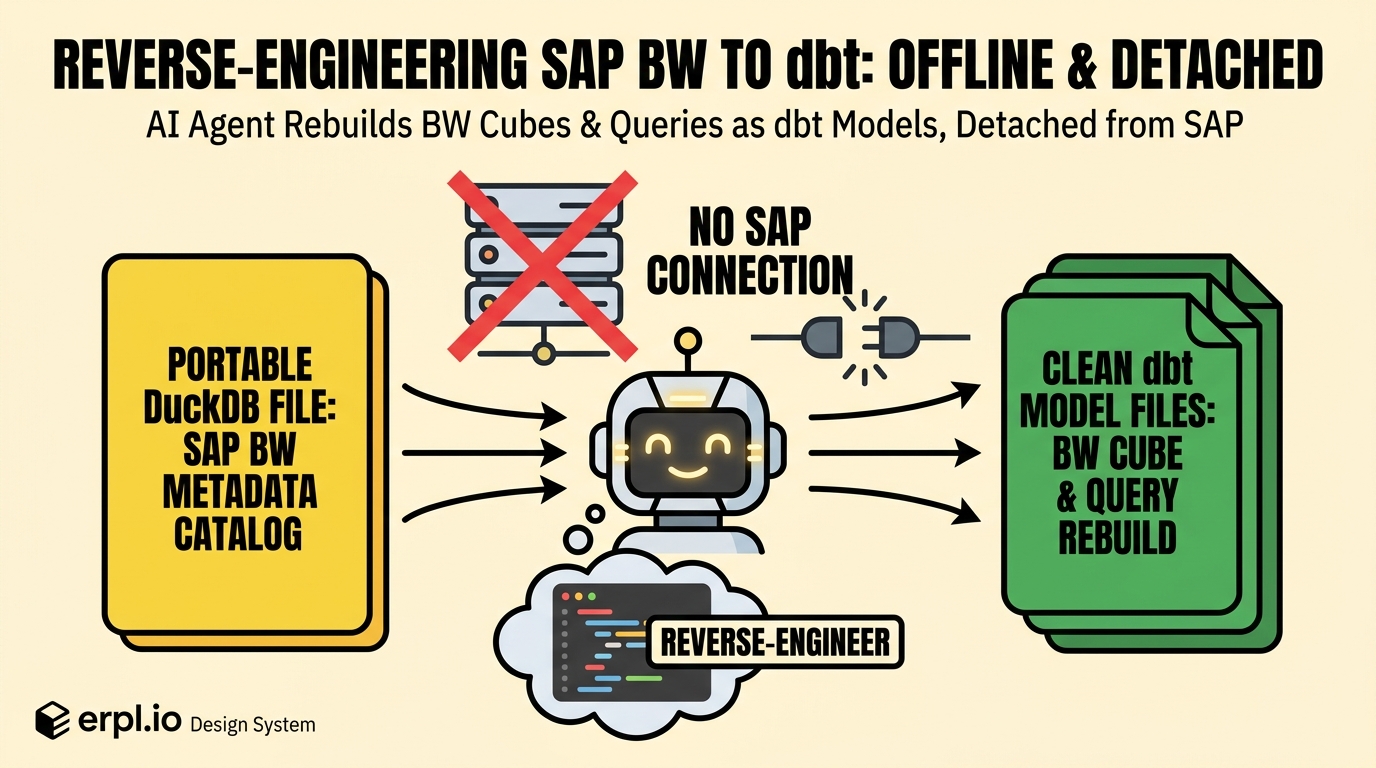
An AI agent reverse-engineering a BW cube into dbt models, offline, with no SAP connection.

In Part 1 we extracted a BW system's metadata into a single DuckDB file with erpl-adt catalog sync — 53 cubes, 226 queries, every characteristic and key figure, all the lineage between them. Browsable, searchable, and completely decoupled from SAP.

Now we do the interesting thing. We unplug.

No SAP credentials in this post. No VPN, no connection, no --host. Just catalog.duckdb — the file from Part 1 — and an AI agent. The goal: take one cube (0D_NW_C01, "Actual for NW Demo") and its flagship query (0D_FC_NW_C01_Q0008, "YTD Sales by Sales Org") and reverse-engineer them into runnable dbt models on DuckDB. Reconstruct the star schema, the measures, and the year-to-date logic — from metadata alone, offline.

Here is exactly how it went.

erpl-rev: SAP Calls Out into DuckDB — 10 Million Rows a Minute

· 9 min read
Joachim Rosskopf
Co-Founder & CEO

Picture the data team at a mid-sized manufacturer. Every night they need a fresh copy of the FI line items — BSEG and friends — in their lakehouse, where the analysts actually live: DuckDB, Parquet on object storage, the odd Iceberg table. The table is wide (hundreds of columns) and deep (tens of millions of rows), and the window is tight. The "official" answer is SLT: stand up a replication server, license it, configure the per-table settings in LTRS, babysit the queue. It works. It is also a lot of machinery — and budget — for what is, conceptually, "read this table fast and write it somewhere open."

I wanted to know how far the cheap path goes. SAP already exposes a perfectly good remote-function interface; DuckDB already ingests at memory bandwidth. What if ABAP just called out into DuckDB — no extension inside SAP, no SLT, no staging files — and we made the read fast enough to matter?

So I built it — two days, with Claude Code as the pair programmer. The result is erpl-rev, and on a throwaway SAP developer trial (single host, over loopback) it replicated 10,000,000 rows of a 400-column BSEG-shaped table in about a minute. It's an early release — a research prototype we're opening up, not an SLT replacement yet — but the numbers were enough to convince me the cheap path is real. Here is the story, the tools, and the numbers.

An AI Agent That Calls Live SAP Data — and Fixes It in ABAP

· 8 min read
Joachim Rosskopf
Co-Founder & CEO

← Part 1: Your SAP Data Is Already Real-Time

In Part 1, a mid-size manufacturer's forecasting team got a live, validated, DuckDB-native view of their SAP order and customer data — fresh within five minutes, anomalies caught at the gate, no warehouse in the middle.

This post is Part 2. It answers the next two questions: how does the AI agent actually reach that data, and what happens when the data is wrong?

The short version: we publish the view as a REST endpoint and an MCP tool with flAPI so the agent can call it, and when the agent finds a bad number it reads the ABAP behind the view, writes a patch, and files a transport with erpl-adt.

Your SAP Data Is Already Real-Time — You Just Need to Stop Caching It

· 8 min read
Joachim Rosskopf
Co-Founder & CEO

Picture a forecasting team at an industrial-controls Mittelstand. Their job for the next quarter: launch an AI-driven inventory and demand-forecasting tool that the operations team will actually trust enough to act on. They have the model. They have the GPUs. They cannot ship.

The reason: their nightly ETL job runs at 02:00 and finishes around 04:00, by which point the model trains on data that's already half a day old. By the time the forecast reaches the procurement system at 08:00, it's reasoning about a world that existed fourteen hours ago. When the CFO asks why the model recommended ordering more of an item that just sold out at lunchtime, nobody has a good answer — because the data the model saw never knew the lunchtime existed.

The fix isn't a better ETL. The fix is removing the ETL.

I Asked Claude Code to Build a CDS View. It Got the Delta Annotations Right.

· 15 min read
Joachim Rosskopf
Co-Founder & CEO

Picture the ecommerce team at a mid-sized retailer. They have just shipped a customer-support chatbot — the LLM-driven kind that fields the "where's my order?" and "can you change the delivery address?" tickets that used to eat a third of the call-centre's day. The bot is good. It is also wrong about fifteen percent of the time, because the order data it reasons about is six hours stale: a nightly job dumps VBAK to a Parquet file, the bot reads the file, and customers find out the bot does not know about anything they ordered after lunch.

The fix is obvious — feed the chatbot from a near-real-time stream. The cleanest compliant path is ODP-via-OData: SAP's Gateway exposes the CDS view as an OData v2 entity set, the consumer follows the !deltatoken=… link, the bot's cache lands inside a five-minute freshness window. (More on why OData and not RFC in a moment — that part is no longer a stylistic choice.) The blocker is the CDS view that the ODP framework reads. If you have ever built one by hand, you know the actual coding is the fast part — five lines of select from. The slow part is the annotation block on top, the half-page of @Analytics.dataExtraction.delta.byElement.name, @AccessControl.authorizationCheck, @VDM.viewType, and the @OData.publish switch that surfaces the view through Gateway. Get one of them wrong and the delta isn't a delta. It's a full snapshot every fifteen minutes, and your ODP queue is on fire by lunchtime.

This is the part of SAP development that an AI pair programmer is very good at, if you give it a real CLI to drive. Last weekend I built the chatbot's feed end-to-end with Claude Code and uvx erpl-adt. No MCP server, no daemon — just Claude Code running shell commands the way a developer would. Eleven minutes from request to active, ODP-ready view. This post is what happened, command by command.

Your AI Coding Agent Just Learned ABAP

· 7 min read
Joachim Rosskopf
Co-Founder & CEO

We built erpl-adt because we got tired of Eclipse being the only way to interact with ABAP systems programmatically. If you wanted to search objects, read source code, or run unit tests against SAP — you had to use Eclipse ADT. No CLI, no scriptable API client, nothing you could plug into a CI pipeline or hand to an AI agent.

So we built one. A single binary that speaks the ADT REST API, works from the command line, and doubles as an MCP server for AI coding agents.